Nigeria to Canada Flights: 19 Things to Know Before You Fly
- Home
- Travel 101
- Nigeria to Canada Flights: 19 Things to Know Before You Fly

19 Facts, From the Month You Fly to the Bag You Land With
Nigeria sends more people to Canada than almost anywhere else on the continent, and the traffic has a shape: it climbs from February, peaks hard in August, drops away, then bumps again in December. So the month you buy a flight ticket from Nigeria to Canada for matters as much as the price. Everything below is from Statistics Canada, the Canadian immigration department, the airport operators and the 2 governments, current as at September 2026.
- August is the busiest month by a distance - 8,050 Nigerian residents flew into Canada in August 2025, against 2,028 in January. Close to 4 to 1 on flights to Toronto from Lagos and everywhere else.
- Term starts in the first half of September - 1 September at Calgary, 8 September at UBC, 9 September at York for 2026-27. August traffic runs a month ahead of it.
- December is the second peak, and no term starts then - 4,956 arrivals in December 2025. That's family, not study.
- December is also Canada's busiest month for long-haul arrivals - The non-US international sector peaked at 1.65 million screened passengers that month, its highest of the year.
- January and February are the floor - Roughly a quarter of August, which is when cheap flights to Canada from Nigeria are easiest to come by.
- Only India and China send more students to Canada - Nigeria has been the world's third source country in 2023, 2024 and 2025 alike.
- Study permits fell by a third and Nigeria's share went up - 37,460 in 2023 to 25,345 in 2025, while Nigeria's slice of the national intake grew from 5.5% to 6.7%.
- Visitor visas and permanent residence rank almost as high - 45,465 visitor visas approved in 2025, and 16,355 people admitted as permanent residents.
- The provincial nominee route is the biggest permanent-residence path - 6,950 of the 16,355 in 2025, ahead of skilled worker and family sponsorship.
- Work permits are the one line still climbing - 17,690 in 2025, and 16,610 in the first half of 2026 alone, against 45,465 visitor visas.
- Two thirds of Nigerian arrivals land at 1 airport - Toronto Pearson takes 67.1%, then Calgary at 9.5%, Montreal 8.8% and Vancouver 7.4%.
- Calgary has nearly 4 times Vancouver's Nigerian-origin population - 8,700 against 2,440 at the last census, and Winnipeg's 4,790 outranks both Montreal and Vancouver.
- An international arrival connecting to a domestic flight clears customs at Pearson - The airport states it plainly. Your bag may have to be collected and re-dropped.
- The train between Terminal 1 and Terminal 3 is free and runs 24 hours - 2 to 8 minutes between stations, with waits of 4 to 8 minutes, and your long haul baggage allowance comes with you.
- Direct flights became legal on 6 August 2026 and none exist - So any Nigeria-Canada flight time you see is still 2 sectors added together plus a layover.
- Your visa does not decide whether you get in - An officer at the border does, and Canada says so in those words.
- Dried and cured meat is not permitted at all - Not suya, not sausage, in any quantity, from anywhere outside the United States.
- Dried fish is capped at 10kg and spices run to 20kg - Other fish and seafood go to 40kg, roe to 1kg.
- Winter is 3 months below freezing in Toronto and 5 in Calgary - Toronto averages -5.0C in January. Winnipeg averages -16.3C.
Most people start this trip by comparing cheap flights to Canada from Nigeria. The more useful question is which month you're flying in and why, because that changes the queue you join, the terminal you land in and the amount of daylight waiting for you outside.
Canada publishes Nigerian arrivals month by month, and the shape is unmistakable. Here's what those numbers say about who buys a flight ticket from Nigeria to Canada, when they buy it, and what happens between the gate at Lagos and the front door of wherever they're actually going.
August Is the Busiest Month, and Term Starts in September
In August 2025, 8,050 Nigerian residents flew into Canada. In January of the same year, 2,028 did. That's a ratio of nearly 4 to 1 between the busiest month and the quietest, and it repeats: the 2026 numbers so far track the 2025 curve almost exactly, 2,085 in January against 8,050 the previous August.
The climb is gradual and the fall is sharp. February 2,476. March 2,961. April 4,267. May 5,126. Then June 7,453 and July 7,300 and the August peak, before September drops to 5,404 and October to 4,599. Anyone booking a flight ticket from Nigeria to Canada in the first half of the year is travelling with a fraction of the crowd that flies in August, and that's true of flights to Toronto from Lagos more than anywhere else.
Now the bit that explains it. Canadian universities start in the first half of September, not in August. Calgary's first day of classes for 2026-27 is 1 September. UBC's winter session term 1 begins 8 September. York's fall term begins 9 September. The arrival peak runs a full month ahead of every one of them.
That gap is deliberate on the traveller's part and it's the single most useful thing here. Students land in August to find accommodation, open accounts, collect documents and get over the flight before a term that starts weeks later. The study-permit numbers agree: Nigerian study permits becoming effective peaked at 3,735 in August 2025 and 3,460 in September, against 1,055 in June. If you're pricing cheap flights to Canada from Nigeria for a September start, you're really pricing an August one.
So the practical reading of a Nigeria-Canada flight time question in August is that the flying's the easy part. Both airports are at their fullest, the accommodation market at the far end is at its tightest, and the margin you build into the itinerary matters more that month than in any other. A flight ticket from Nigeria to Canada bought for late August buys you the busiest version of this journey.
Only India and China Send More Students to Canada
Three rankings describe the shape of this route, and they come from 3 separate Canadian immigration tables. Nigeria sits behind only India and China for study permits, in 2023, 2024 and 2025 alike. It sat third for approved visitor visas in 2025, and fifth for permanent residents admitted. That's the audience buying a flight ticket from Nigeria to Canada, in order of size.
The study-permit line tells a story that surprises people. Nigerian study permits fell from 37,460 in 2023 to 26,430 in 2024 and 25,345 in 2025 — a drop of roughly a third in 2 years. Canada capped study-permit applications from 22 January 2024, and the published national total fell much harder, from 680,670 to 380,680 over the same period. So Nigeria's slice of Canada's student intake grew while its own number shrank, from 5.5% to 6.7%. Fewer people, a bigger share.
The cap tightened again for 2026: Canada expects to issue up to 408,000 study permits, of which 155,000 go to newly arriving students and 253,000 are extensions, against 437,000 in 2025. Application spaces dropped from 550,162 to 309,670. The cap is allocated to provinces, not to countries — there's no Nigeria-specific quota anywhere in it.
Permanent residence moves on a different rhythm. Nigerian admissions rose to 20,395 in 2024, the year study permits fell, then eased to 16,355 in 2025. The provincial nominee route is the largest single path in every year: 6,950 of the 2025 total, ahead of skilled worker at 2,865 and Canadian experience at 1,655. Family sponsorship accounted for 2,525, of which 1,480 were spouses or partners and 800 were parents or grandparents.
Visitor visas approved to Nigerians ran 79,275 in 2023, 51,425 in 2024 and 45,465 in 2025. Work permits are the one line still climbing: 17,690 issued under the international mobility programme in 2025, then 16,610 in the first 6 months of 2026 alone. Anyone weighing cheap flights to Canada from Nigeria against the calendar should note that the 2026 figures in this section cover January to June only, and a Nigeria-Canada flight time in that half-year says nothing about the rest of it.
One thing worth saying plainly: those 4 streams can't be added together. Canada publishes them in 4 tables with 4 different definitions — a visa approved isn't a journey taken, a permit becoming effective isn't the same as somebody arriving, and one person can legitimately appear in 3 of them in the same year. The rankings are the honest summary. A pie chart wouldn't be. What they do tell you is that flights to Toronto from Lagos carry 4 quite different passengers, and the border treats each of them differently.
December Is the Other Peak, and It's Canada's Busiest Month Too
December 2025 brought 4,956 Nigerian residents into Canada, well above November's 3,462 and roughly double January's. No Canadian term starts in December. This is the visiting season, it behaves nothing like the August one, and it's when cheap flights to Canada from Nigeria are hardest to find.
It also lands you in the worst month for the airport. Canada's non-US international sector — the long-haul traffic that a flight ticket from Nigeria to Canada belongs to — peaked at 1.65 million screened passengers in December 2025, its highest month of the year, with January close behind at 1.63 million. Toronto Pearson's own non-US international peak was the same month, at 766,879.
That's the opposite of the pattern for total traffic, which peaks in July. Long-haul and short-haul run on different calendars, and the December traveller from Lagos is arriving in the middle of the long-haul crunch while the domestic terminals are relatively quiet.
Pearson's published guidance is 3 hours before an international or US departure and 2 hours before a domestic one, broken out by terminal. In December that 3-hour figure is the one to take literally in both directions. Security screening across Canada's busiest airports has been holding up — 96% of passengers waited under 15 minutes in the year to June 2026, and 91.7% during peak periods — but that's the screening queue, not the customs hall, and it's an average across a year that includes February.
The quiet months, if you've a choice, are the ones nobody thinks of: October and November on the Nigerian curve, April and May on the Canadian long-haul curve. Flights to Toronto from Lagos in late October meet the smallest crowd at both ends of the trip, and the Nigeria-Canada flight time is the same in October as it is in December.
67% of Nigerian Arrivals Come Through 1 Airport
Statistics Canada's published arrivals data names Nigeria as a country of residence, and of Nigerian residents arriving by air between July 2024 and July 2026, 67.1% landed at Toronto Pearson. Calgary took 9.5%, Montreal 8.8%, Vancouver 7.4%, Ottawa 2.6% and Edmonton 2.0%. That concentration is why flights to Toronto from Lagos dominate the results even for people whose destination is 3,000km further west, and why a flight ticket from Nigeria to Canada so often means a ticket to Ontario.
Where those people are actually heading is a separate question, and the census answers it in an order most travellers get wrong. Of 69,540 people in Canada reporting Nigerian origin at the last census, Ontario held 36,750 — more than half the country's total. Alberta was a strong second at 14,600. Then Manitoba at 5,580 and British Columbia at 4,110.
By city the ordering is sharper still. Toronto 22,065. Calgary 8,700. Winnipeg 4,790. Edmonton 4,390. Ottawa-Gatineau 4,200. Montreal 2,785. Vancouver 2,440.
Read that twice. Calgary has nearly 4 times Vancouver's Nigerian-origin population. Winnipeg, which almost nobody books through, outranks both Montreal and Vancouver. If you're joining family, the odds are better than even that the address is in Ontario, and close to 1 in 4 that it's in Alberta or Manitoba — neither of which is a place a flight ticket from Nigeria to Canada lands directly.
The census figure is 5 years old and the next comparable release is 2027, so treat it as the settled shape rather than this year's number. The arrivals data, current to 2026, points the same way: Toronto first by a wide margin, Calgary second, Montreal and Vancouver clustered behind. Anyone comparing cheap flights to Canada from Nigeria on price alone is comparing the first leg of a 2-leg trip.
Toronto Is Usually Not the Destination
Which brings the connection into focus. If Pearson takes two thirds of the arrivals and Toronto holds under a third of the population, a large share of people booking flights to Canada from Nigeria are getting on another aeroplane after Toronto. Most searches for flights to Toronto from Lagos are really searches for somewhere else.
Pearson is explicit about what that involves. If your flight into Pearson is international and your flight out is domestic, you clear Canadian customs and immigration there. Not at your final city. The long-haul sector ends with a border, and the domestic one starts after it. That's true of every flight ticket from Nigeria to Canada that ends somewhere other than Ontario.
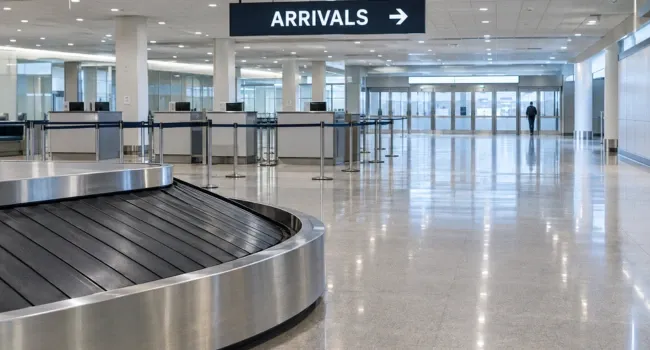
Baggage is deliberately less definite, and the airport's own wording is worth having: if your bag's tagged to your final destination you may need to collect it and put it on the connection drop-off belt; if it isn't tagged through, you'll definitely need to collect it and check it in again. Ask at first check-in in Lagos whether the bag needs collecting anywhere. That's a 30-second question that decides whether a 2-hour connection is comfortable or impossible, and it matters on every one of those flights to Toronto from Lagos.
Terminals matter too, and this part is easy. The Terminal Link train between Terminal 1, Terminal 3 and Viscount Station is free and runs 24 hours a day, 2 to 8 minutes between stations with waits of 4 to 8 minutes. Not all connecting passengers go through Pearson security again; the airport publishes a connection guide that tells you whether you do.
Two structural points follow. One ticket or 2 changes everything: on 1 ticket the carrier owns the misconnection, and on 2 the risk's yours. And an allowance bought on the international leg doesn't automatically carry onto a separately ticketed domestic flight, which is where people find their long haul baggage allowance has quietly shrunk between Toronto and Calgary.
You can file the Canadian customs declaration up to 72 hours before you land and use the express lanes on arrival. It doesn't skip the officer. It skips the main queue, and after a long day in the air that's worth having on any flight ticket from Nigeria to Canada.
The Non-Stop Became Legal in August and Nobody Flies It
On 6 August 2026 Canada and Nigeria signed an expanded air transport agreement. The previous treaty was code-share only, which meant a genuine non-stop between the 2 countries was not legally possible. The new one allows direct flights for the first time, with 14 weekly passenger services each way and 10 weekly all-cargo services, and cargo gets fifth-freedom rights to pick up and set down in third countries along the route.
Then nothing happened. No airline's been designated, no city pair named, no start date announced. So a flight ticket from Nigeria to Canada bought today is still 2 sectors with a country in between, exactly as it was in July, and cheap flights to Canada from Nigeria still mean a stop somewhere.
Fourteen a week each way is 2 a day, which is a real network rather than a token opening. It's the number to remember when someone tells you a non-stop is imminent: the room exists, the aircraft don't, and a flight ticket from Nigeria to Canada still routes through a third country.
Meanwhile the country in the middle has a say. Every routing goes through somewhere — a European, North African or Gulf hub — and that hub's transit rules apply to you for the hours you're in it, whatever your Canadian paperwork says. A Nigeria-Canada flight time quoted anywhere is 2 sectors added together plus a layover, so it moves with the connection rather than the distance. A 3-hour gap and a 9-hour gap give the same total on paper and completely different days.
Which is why the connection, not the airborne hours, is the thing to compare when cheap flights to Canada from Nigeria throw up 2 itineraries that look alike. Two flights to Toronto from Lagos at the same total duration aren't the same trip.
Your Visa Gets You On the Plane. An Officer Decides the Rest.
Canada states it directly: a valid visa and travel document don't guarantee entry. A border services officer decides on arrival. That's as true of a student in August as of a grandmother in December, and it's why the last hour of a flight ticket from Nigeria to Canada deserves more thought than the whole flight before it.
The officer can ask why you're visiting, how long you're staying, and for evidence of the money funding the trip. Most visitors get up to 6 months, but an officer can write a shorter period into your passport, and that written date is the one that counts rather than the one on the visa.
A referral to secondary examination is not an accusation. An officer there can ask for detail about your plans, inspect luggage, wallet and personal digital devices, look over an animal travelling with you, ask for evidence of available funds and count cash in front of you. Referrals also happen at random, and the published policy is that they aren't made on the basis of race, nationality, religion, age or gender. That policy is published in full.
Your phone is the part people don't expect. Personal digital devices are goods under the Customs Act, you're obliged to give the password on request, and refusing means the device can be detained. Examinations are meant to follow indicators of a border-law breach, and between November 2017 and December 2025 they touched 0.007% of travellers and their goods — a small number attached to a large consequence.
None of this is advice on how to answer. It's the shape of the encounter, so meeting it at the end of a December flight isn't a surprise. It's the same encounter whatever you paid, and cheap flights to Canada from Nigeria don't change it either way.
Dried and Cured Meat Does Not Get In
This is the rule that catches the most bags on this route. Fresh, dried and cured meats are not permitted into Canada from anywhere outside the United States, in any quantity. Not suya, not kilishi, not sausage, not cured ham. Game animal carcasses and eggs are prohibited outright.
Commercially prepared meat is the narrow exception and the conditions are strict: cooked, shelf-stable, sealed, and marked with its country of origin, up to 20kg. A homemade version of the same thing, however well sealed, is not commercially prepared.
Fish runs on 3 separate limits and the numbers are more generous than people assume. Dried fish stops at 10kg. Other fish and seafood run to 40kg. Roe stops at 1kg. So a December traveller carrying dried fish for family is inside the rules at 10kg and outside them at 11, and the difference is a declaration rather than a guess.
The consequence of getting it wrong isn't usually the item. It's the referral, at the end of a long flight, in the month when the hall's busiest. Weigh it against your long haul baggage allowance before you pack, not at the carousel.
What Does Get In, in Kilograms
The permitted list is wider than the prohibited one and almost nobody knows it. Spices, tea and coffee go up to 20kg, which is the most generous limit on this route and the least used. Baked goods, confectionery and most shelf-stable prepared foods travel fine.
Medicine has its own rule and it's specific: a 90-day supply, in the packaging it came in, with the label intact. Decanted into an unlabelled container it can be refused, however ordinary the contents. That one matters most for the grandparents travelling in December, who are the most likely to be carrying a long prescription and the least likely to have kept the box.
Personal goods have 4 conditions and every one has to hold: they must be yours, they must be for your own use, they must not be for sale, and they must not be intended for somebody else in Canada. A gift carried for a relative is the boundary case people trip over, and it's worth declaring rather than arguing about.
Your long haul baggage allowance is the container all of this travels in, so the practical limit is usually the weight on your ticket rather than the number in the regulation. Twenty kilograms of spices is generous on paper and heavy in the hold, and it's the sort of thing that quietly decides which flight ticket from Nigeria to Canada is actually the cheaper one.
Winter Is 3 Months in Toronto and 5 in Calgary
The month you fly decides the weather you land in, and Canada's published normals mean nobody has to guess. Toronto averages -5.0C in January, -4.4C in February and -1.6C in December: 3 months below freezing on the daily average. July averages 22.1C.
Calgary is colder and longer. January -7.6C, February -5.9C, March -2.2C, November -1.7C, December -6.3C: 5 months below zero. Winnipeg, which holds the third-largest Nigerian-origin population in the country, averages -16.3C in January — 11.3 degrees colder than Toronto in the same month.
Set that against the arrivals curve and something useful appears. August, the peak month, is the mildest possible landing. December, the second peak, drops people into the coldest part of the year in the cities they're most likely heading to, and January and February are colder still. The winter intake at Canadian universities starts on 4 January at York, 5 January at UBC and 11 January at Calgary — the 3 hardest weeks of the year to arrive into.
Those are climate normals covering 1991 to 2020, so they're a 30-year average rather than a forecast. As planning numbers for what goes in the suitcase they're better than any adjective, and they belong in the same decision as the price when you're sorting cheap flights to Canada from Nigeria by month.
10 Things to Settle Before You Book
Every one of these comes from a published rule or a published figure, and every one can be settled at home rather than at a counter. None of them turns on which of the cheap flights to Canada from Nigeria you end up on.
| What to do | Why it earns its place |
|---|---|
| Fly in October or November if the date is yours to choose | The Nigerian arrival curve sits at 4,599 and 3,462 in those months against 8,050 in August, and the Nigeria-Canada flight time is identical in every one of them. |
| Land 3 to 4 weeks before term, not 3 days | Term starts between 1 and 9 September and the August peak exists because people give themselves that margin. |
| Allow 3 hours at the airport in both directions | It is Pearson's own published figure for international departures, and December is the busiest long-haul month of the year. |
| Ask at Lagos check-in whether the bag is tagged through | Pearson won't answer it for you, and on flights to Toronto from Lagos the answer decides whether a 2-hour connection works. |
| Book the onward domestic leg on the same ticket | On 1 ticket the carrier owns a misconnection. On 2 the risk's yours, and the allowance may not carry across. |
| Check the long haul baggage allowance against the domestic leg | They're frequently different numbers, and the smaller one applies after Toronto. |
| File the customs declaration in the 72 hours before landing | It does not skip the officer. It skips the main queue. |
| Weigh the dried fish before you pack it | 10kg is the line. Other seafood runs to 40kg and roe to 1kg, and the categories are counted separately. |
| Leave every kind of dried or cured meat at home | Not permitted in any quantity from outside the United States, however it is wrapped. |
| Carry medicine in its original box | A 90-day supply with the label intact. Decanted into an unlabelled container it can be refused. |
The Month You Pick Shapes the Whole Trip
Strip this route back and it's 3 decisions, and only 1 of them is the aeroplane. Which month you go, because August and December are crowded for 2 completely different reasons and October isn't crowded at all. How the connection's ticketed, because Toronto is where the border happens and rarely where the trip ends. And what's in the bags, because that's the only part an officer can see, and your long haul baggage allowance decides how much of it there is.
The direct flight will come. Fourteen weekly services each way are sitting in a treaty signed in August 2026, and when an airline claims them the Nigeria-Canada flight time drops and the whole trip gets simpler. Until then it's 2 sectors, a country in the middle, and a border at the end where somebody who's never seen your application makes the decision. That's what a flight ticket from Nigeria to Canada actually buys today.
Get the month, the ticket structure and the bags right and the rest is a long flight with a good ending. If the connection's what's driving the choice on flights to Toronto from Lagos, business class deals from Nigeria are as much about the ground time as the seat.
Disclaimer - This is general information drawn from Canadian and Nigerian government sources, Statistics Canada and the Canadian airport operators, current as at September 2026, and it is not immigration, customs or travel advice. Entry rules, import limits and published statistics change without notice, so confirm anything that matters to your trip with the relevant authority before you travel.
Frequently Asked Questions
When Is the Busiest Time to Fly From Nigeria to Canada?
August, by a wide margin. Canada counted 8,050 Nigerian residents arriving by air in August 2025 against 2,028 in January. December's a clear second at 4,956, and it's also the busiest month of the year for long-haul arrivals into Canada generally. October and November are the quietest months that still carry decent schedules, and cheap flights to Canada from Nigeria are easiest to find in them.
Why Do So Many People Arrive in August When Term Starts in September?
Because a month of margin is worth having on any flight ticket from Nigeria to Canada. Canadian terms began on 1 September at Calgary, 8 September at UBC and 9 September at York for 2026-27, and students land ahead of that to sort accommodation, banking and paperwork. The study-permit figures follow the same curve, peaking at 3,735 in August 2025.
How Many Nigerians Go to Canada Each Year, and For What?
Nigeria ranks third in the world for Canadian study permits, third for approved visitor visas and fifth for permanent residence. In 2025 that was 25,345 study permits, 45,465 visitor visas and 16,355 permanent residents admitted, plus 17,690 work permits. The streams are published separately and can't be added together, because a visa approved isn't a journey taken and one person can appear in more than one of them.
Do I Clear Canadian Customs in Toronto or at My Final City?
In Toronto, if your onward flight is domestic. Pearson states that an international arrival connecting to a domestic departure clears Canadian customs and immigration there. Your bag may need collecting and re-dropping too, and your long haul baggage allowance may not carry onto a separately ticketed domestic leg — both worth asking about at check-in in Lagos rather than discovering at the carousel.
Is There a Direct Flight From Nigeria to Canada Yet?
No. An expanded air transport agreement signed on 6 August 2026 makes one legal for the first time, allowing 14 weekly passenger flights each way where the previous treaty permitted code-shares only. No airline, route or start date's been named, so every flight ticket from Nigeria to Canada on sale today still involves a stop, and any Nigeria-Canada flight time you're quoted is 2 sectors plus a layover.
How Cold Is It When I Land?
It depends entirely on the month. Toronto's daily average sits below freezing in December, January and February, bottoming at -5.0C, and reaches 22.1C in July. Calgary's below zero for 5 months. Winnipeg averages -16.3C in January. Those are 30-year climate normals rather than a forecast, but they're the right numbers to pack against, and they're the same whichever of the flights to Toronto from Lagos you take.
 Nikita Aswani