9 Places to Visit in Mombasa: The Month Each One Peaks
- Home
- Travel 101
- 9 Places to Visit in Mombasa: The Month Each One Peaks

9 Places, and When to Go to Each
The Kenyan coast doesn't have one good season, it has two opposite ones, and which of them you want depends on whether you came for the water or the forest. Here are the 9 places to visit in Mombasa and along the coast that are worth your time, and the month each of them is at its best.
- Fort Jesus - a Portuguese fort with 4 centuries of occupiers layered into the coral stone, and the anchor of any list of places to visit in Mombasa. June to September.
- Mombasa Old Town - carved doors, the 1507 Mandhry Mosque, somebody's actual neighbourhood. June to September.
- Haller Park - a dead limestone quarry turned into forest, with giraffe that eat out of your hand, and the gentlest of the Mombasa attractions. June to September.
- Diani Beach - 17km of sand behind a reef, and rope bridges over the road for monkeys. November to March.
- Shimba Hills - Kenya's only sable antelope, and a walk down to a waterfall you can swim under. June to September.
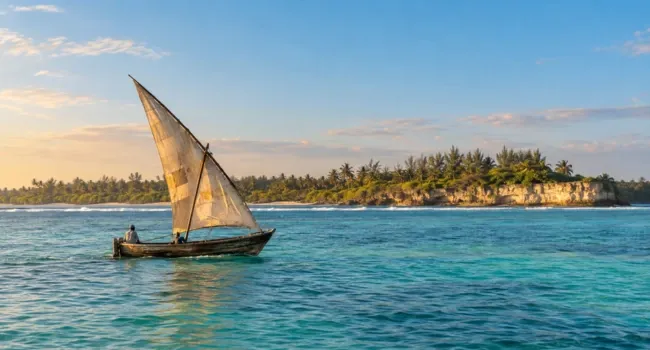
- Kisite-Mpunguti and Shimoni - a day under sail, dolphins that live there all year, and a hard hour in the slave caves. August to October.
- Watamu and Mida Creek - coral gardens, a turtle hospital and a mangrove boardwalk. August to October.
- Gede Ruins - a Swahili town the forest took back, and the country's newest World Heritage Site. June to September.
- Arabuko-Sokoke - the biggest coastal forest left in East Africa, with birds found nowhere else. November to April.
Facts here come from UNESCO, the National Museums of Kenya, the Kenya Forest Service, Kenya's marine mammal researchers, published climate records and government holiday listings, checked in September 2026.
The 2 Monsoon Seasons, and Which One You Want
Everything about a Kenya coast travel plan runs on 2 monsoon seasons, and if you don't know anything else, know this. The kaskazi blows in from the north-east from about November to March. The sea goes flat, the water warms up, and visibility on the reefs runs to 30 metres on a good day. This is the coast in the photographs, and if the water is why you're coming, that settles the best time to visit Mombasa before you read another line.
Then it turns. The kusi arrives from the south-east around April and stays to September, bringing swell, chop and runoff. The sea drops a few degrees and clouds up. Boats still go out, but half the Mombasa attractions here are underwater, and underwater is a different proposition in July.
So: go in kaskazi. Except the forest and the hills work the other way round entirely, which is the tension underneath every recommendation below. It's why there isn't one answer to the best time to visit Mombasa, and why the 9 places to visit in Mombasa and the coast below don't share a season.
One number to carry. April and May bring 154mm and 236mm of rain, more than any other month by a wide margin, on top of the year's highest humidity. If your dates can move, move them.
Fort Jesus, Where 4 Centuries Sit in One Building
Start where everybody starts. You come up off the road into a fort fought over by 4 empires, and the first thing you do is climb. The ramparts and the 5 bastions look down over the old harbour, and from up there the geography of the city makes sense - why anybody built here, and why so many wanted it. Of all the places to visit in Mombasa this is the one that explains the others.
Then you drop into the galleries, built around what archaeologists dug out of Gede, Manda and Ungwana. An 18th-century Omani house stands in the courtyard, with rotating art shows beside it, and after dark there's a sound and light show thrown across the walls.
UNESCO listed it in 2011 and calls it one of the most outstanding and well preserved examples of 16th century Portuguese military fortification. It went up between 1593 and 1596 to an Italian architect's design, and you can read the Portuguese, Arab, Omani and British layers off the stonework once somebody points them out.
Most people give it 45 minutes to an hour, or 2 to 3 hours carrying on into Old Town, which is the obvious move since the gate opens onto it. Guides wait outside and you don't need one, but the ground is uneven coral rag and a good guide turns a wall into a story.
Fort Jesus opens at 8 in the morning and last entry is 5. You'll see 6pm quoted in places, so if you're arriving late, work to the earlier close and you'll never be the person turned away at the gate.
Best month is June to September. March gets to nearly 34 degrees and is already humid, then April and May add the rain. June through September runs 3 to 5 degrees cooler with a breeze off the water, and on a stone fort with no shade that's the whole difference between a good hour and a long one.
Mombasa Old Town and Its Carved Doors
Of all the places to visit in Mombasa, this is the walk people remember.
You go up Ndia Kuu, narrow enough that 2 cars can't pass, past the Mandhry Mosque - built in 1507, the oldest in Kenya, still in daily use. Past the old Africa Hotel from 1901, past the former Alidina Visram trading office that's a gallery now. What you'll photograph is the doors: Swahili, Indian and Zanzibari carving, and the bigger the door the more important the household behind it, so you can read a street's old pecking order walking down it.
One thing to understand before you go. Old Town isn't a heritage precinct. It's an inhabited, largely Muslim neighbourhood where people are getting on with their day while you photograph their front door. Cover shoulders and knees, carry a scarf if you might step into a mosque, and ask before you point a camera at anyone. Do that and people are welcoming.
You don't need a guide here, though certified ones work the area by Fort Jesus if you want the buildings named. Old Town is one of the few places to visit in Mombasa that costs nothing at all.
Best month for Old Town is June to September, same comfort logic as the fort. But check the Ramadan dates below before booking, because they change what's open at lunchtime more than anything else on the Mombasa attractions map.
Haller Park, Where a Quarry Became a Forest
A giraffe's tongue is about 45cm long and dark purple, and you learn both from a raised platform at Haller Park with a handful of pellets and no fence between you. That's the bit people come back talking about. Around it there are scheduled feeds for the hippos and the Nile crocodiles, and a tortoise called Mzee who is somewhere near 130 years old and entirely unbothered by any of it.
Walk the trails and there are eland, oryx, waterbuck, vervet monkeys, a reptile house and 160-odd bird species. Two to 3 hours covers it, which makes it the easiest of the Mombasa attractions to drop into a spare afternoon.
The story under your feet beats the animals. In 1952 this was a cement quarry - bare limestone, nothing growing, the sort of ground that stays dead. From 1959 René Haller planted casuarina trees and brought in red-legged millipedes, because the millipedes would eat the tannin-heavy needles and turn them into soil. It worked. More than 180 indigenous species took hold in what that soil became, and the forest you're walking through is somebody being patient for 40 years.
Feeding times run around 2:45pm for giraffe, 4pm for hippo and 4:30pm for crocodile, but they shift, so confirm at the gate rather than arriving at 4:29. Open daily 8am to 5pm, last entry 4:30pm, which is easier to plan around than most Mombasa attractions.
One thing worth knowing: those photographs of Owen the orphaned hippo asleep against Mzee the tortoise are from 2004, and you won't see it. The park's position is that Owen was later relocated to live with other hippos, while Mzee remains part of the park's reptile community. Mzee is still there. Owen isn't.
Best month is June to September for walking comfort, though of all the places to visit in Mombasa this is the most weather-proof. Shade everywhere, and the animals keep their schedule whatever the sky does.
Diani, and Why the Water Is Always Flat
The first thing you notice at Diani Beach is how quiet the water is. That's the reef, sitting 1 to 2km out along all 17km of sand between the Kongo River and Galu. It takes the swell before the swell reaches you, leaving a lagoon that stays between 25 and 29 degrees more or less all year, which is why photographs here look calm when photographs of other Indian Ocean beaches look like surf.
Now look up. Rope bridges run between the trees along the Diani Beach road, and once you've spotted one you'll see them everywhere. They're colobridges. Fewer than 400 Angolan colobus monkeys are left on this coast, roughly 55 a year get hit by cars, and only about a fifth of their forest survives, in fragments - so they had to cross the road between them. Now they cross above it. The group behind the bridges runs a visitor centre, and it's one of the few Mombasa attractions where turning up funds the thing you came to see.
This is the busiest stretch of coast for organised activity. Kitesurfing works nearly year-round because both monsoons deliver wind - December to March on the kaskazi, June to September on the kusi. Diving and snorkelling run off the same reef, and there's a skydiving drop zone at Ukunda if you'd rather see the lagoon from 10,000 feet.
Best month at Diani Beach is November to March: calm water, the year's best visibility, warmest sea, and the clearest answer to the best time to visit Mombasa if the water is why you came. There's a whale shark window opening in November and running to around March, but be honest with yourself about it. Kenya isn't on the global lists of reliable whale shark sites, so treat a sighting as a good day rather than a reason to book.
Shimba Hills, Sable Antelope and a Waterfall You Can Swim Under
This one breaks the pattern, and it's the most useful thing on the page.
Shimba Hills is rainforest, woodland and grassland rather than savanna, so you're looking into green rather than across open ground. It holds Kenya's only breeding sable antelope, around 100 animals, and a big elephant herd, and over half of Kenya's rare plant species grow in its 192 square kilometres. It's also the one entry here that answers the best time to visit Mombasa question backwards.
What most people come to Shimba Hills for is the walk down to Sheldrick Falls, a 21-metre drop with a pool underneath that visitors swim in. It's 5km there and back, and a Kenya Wildlife Service ranger has to come with you, on walks leaving at 10am and 2pm. The ranger is there for your safety, not to name the birds, so if you want the forest explained you need a guide as well as an escort.
Because it's thick forest rather than open plain, game viewing isn't as reliable as an inland park. Some days you see a lot, some days you see leaves. What you get in exchange is the rare chance on a Kenyan trip to get out of the vehicle and walk.
Best month is June to September - exactly when the beach is at its worst. The reserve's coolest, driest run is the kusi window, around 27 degrees, while April to May and October to November bring the storms. Want Shimba Hills and flat calm water on one trip? You can't have both.
Sailing to Kisite-Mpunguti from Shimoni
This is the best day out in Kenya coast travel and the one most visitors end up doing twice.
You leave Shimoni on a traditional dhow, loop around Wasini Island and moor over coral gardens inside a reef that runs unbroken from here to Malindi. Under you: clownfish, turtles asleep in the coral, stingrays moving over the sand. Around you, most days, dolphins.
Kisite is 28 square kilometres with another 11 in the reserve around it and 4 small islands inside the reef. Life jackets come with the boat, so it works even if you're not a confident swimmer. Two things make or break the day: go in the morning, and time the snorkelling within about 2 hours of low tide.
The same trip usually includes the Shimoni slave caves, and they change the mood of the afternoon completely. It's a community-run museum in caverns the sea reaches, where people were held in stone tanks before being shipped out. The chains are still set into the rock. It isn't a light hour, and it's the more important half of the day.
The Dolphin Rules Worth Reading Before the Boat
Indo-Pacific bottlenose dolphins live here in family groups of 5 to 25, and the rules bind your skipper rather than you. The boat stays 50 metres to the side and 100 metres ahead or behind, no more than 3 boats within 50 metres of one group, and nobody gets in the water with them - which surprises people who've paid for a dolphin trip. Crowded dolphins turn aggressive, and it's their sea.
One myth worth killing before you book. You'll hear that dolphins are here from October to March. That season is really a description of when tourists come, not where the dolphins are: research published in 2021 found they stay within 2km of shore all year. So if your dates land in June, book the trip anyway.
Best month is August to October if whales are what you want, because humpbacks pass from July to October with the peak in August and this is one of the 2 places people watch from. November to March if the reef itself is the point. Few places to visit in Mombasa and its hinterland split that cleanly down the middle of the year.
Watamu, Mida Creek and the Turtle Hospital
Of the Mombasa attractions up the north coast this is the biggest, and it's really 3 days in one place.
The marine park is 10 square kilometres of coral gardens inside a 32 square kilometre reserve, with 150 coral species and over 500 fish species. Green and hawksbill turtles, manta rays, moray eels. The shallow gardens in Turtle Bay sit in a couple of metres of water, so you can snorkel them without being a diver, and a glass-bottom boat works if you'd rather stay dry.
A short drive away, Mida Creek has a 260-metre boardwalk through the mangroves to a bird hide. A conservation charity built it in 2012, and the money it takes pays school bursaries for local children, which makes walking it a slightly different act than walking a boardwalk usually is.
The turtle work is the other reason to come. Since 1998 the local conservation organisation has released more than 24,000 turtles that came up in fishing nets, protects 50 to 100 nests a season, and has treated over 800 injured turtles at a centre you can walk round. You'll see animals mid-recovery, which beats any aquarium.
Best month is August to October, the rare case where 2 things line up. Humpback whales pass between July and October, and Watamu is the most reliable place on the coast to watch them from dry land. Turtle hatching runs August to October in the same window. You'll also see nesting given as December to March - so if the hatch is why you're going, ask the turtle centre for this year's dates, because they track the nests themselves and will know.
For birds instead, come November to April, when Mida Creek fills with shorebirds wintering down from Europe and Asia. Watamu sits about 2 hours north of the city, so it works as a second base rather than a day trip, and the hour on Nairobi to Mombasa flights makes two separate coastal trips in opposite seasons a realistic idea.
Gede Ruins, a Swahili Town the Forest Took Back
You walk in off a road, through a gate, and 20 metres later you're between coral-stone walls with trees growing out of them. Gede is a whole town - 2 rings of wall, a sheikh's palace, 3 mosques, houses with drainage and lavatories, pillar tombs - standing in forest 5km inland. Butterflies go past. Sykes' monkeys watch from the walls. It's one of the few places to visit in Mombasa's hinterland where you're alone with something old.
The small museum has Chinese, Venetian, Persian and Indian goods pulled out of the ground here, which is the real story: this wasn't an outpost, it was a town wired into the Indian Ocean trade.
Gede became Kenya's 8th UNESCO World Heritage Site on 27 July 2024, as the Historic Town and Archaeological Site of Gedi. If your guidebook predates that it won't say so, and neither will most lists of places to visit in Mombasa and the coast.
Why the town emptied is genuinely unsettled. Portuguese pressure on trade, raids, political trouble after Malindi's sheikh was deposed, water running short - the wells were dug deeper over time, which points somewhere. A guide who gives you the answer confidently is giving you a preference. Enjoy that. It's more interesting unsolved.
Allow a few hours. Guides wait at the entrance and walking it alone is normal. Opening hours aren't posted reliably, so go in the morning and you'll be fine, which also gets you the light and the birds. It's among the more relaxed Mombasa attractions to arrange on the day.
Best month is June to September, same as the other stone sites, since it's exposed and April and May are the wettest of the year. Pair it with Arabuko-Sokoke next door and you've covered 2 of the 9 places to visit in Mombasa and along the coast in one morning.
Arabuko-Sokoke, the Last Big Coastal Forest
This is 420 square kilometres of dry coastal forest, the largest intact block left in East Africa, and it closes the list of places to visit in Mombasa and its coast on a different note entirely. Marked trails, 30km of driving track, and a silence you won't have had anywhere else on the trip.
People come for birds. Over 230 species have been recorded, roughly a fifth of Kenya's list, several of them found nowhere else on Earth. The other thing to look for is the golden-rumped sengi, an elephant shrew with about 90% of its whole world population inside this one forest. It's active in daylight and spends most of it turning over leaf litter, so a slow morning walk is your shot. It hits 25km an hour when it decides you're a threat, which you are.
Guiding is run by a community association based at the forest rather than a national agency, and entry is ticketed at the gate between 6am and 6pm.
One thing to get right if you're a birder: Clarke's Weaver feeds here and is closely associated with this forest, but the only breeding colony ever documented was in a seasonal wetland at Dakatcha, north-west of Malindi. Nests were active in March and April and the colony had emptied by the 19th of April.
Best month is November to April for the migrants arriving from Europe and Asia. January to February, or July to October, if the trails and residents matter more, because the tracks turn slippery in the rains even though the forest stays open. There's no best month for the sengi, which mates year-round, so that part of a Kenya coast travel plan sorts itself out.
The Places That Nearly Made the List
Four more places to visit in Mombasa and along the coast, each worth a half day.
- Jumba la Mtwana - a smaller Gede, 15km north of the city near Mtwapa Creek, with 4 mosques, a tomb and 4 houses from a settlement occupied in the 14th century. The ruins sit directly above the beach, which Gede doesn't.
- Mnarani - a pillar tomb, a Friday mosque and 12 labelled tombs on a bluff above Kilifi Creek, 55km north, up 112 steps from the old ferry road. Worth it for the view over the creek alone.
- Malindi Marine National Park - the first marine national park declared in Africa, in 1968, a compact 6 square kilometres next to Watamu with over 600 fish species and glass-bottom boats. One of the quieter Mombasa attractions.
- Kaya Kinondo - one of the Sacred Mijikenda Kaya Forests, UNESCO-listed in 2008, and the only one of the 10 open to visitors. The Digo community runs a 90-minute guided visit. Shorts and short skirts aren't permitted and some areas can't be photographed. The rules are the experience, not an obstacle to it.
Getting between them is straightforward now, which is what makes Kenya coast travel easier than it was. Diani runs 30 to 60 minutes from the city on the bypass, Kilifi about 55 minutes, Shimoni an hour and 45, Watamu 2 to 2.5 hours, Malindi under 3.
Why Lamu Is Not on This List
Lamu Old Town is UNESCO-listed and probably the most extraordinary place anywhere on this coast. It's also the subject of a live disagreement between 2 governments, which has to be said plainly rather than glossed over.
The United Kingdom advises against all travel to Lamu County except Lamu Island and Manda Island, and even there says fly rather than drive and stay particularly vigilant. The United States lists Lamu at its highest warning level with no exception for the islands, citing kidnapping and terrorism. Both were current in the second half of 2026.
Two governments looking at the same place have reached different conclusions, and that isn't something to settle from a desk. Check both advisories on the day you book, and note that everyone who does discuss going says fly.
The Worst Month, and the Best One
Somebody has to say it. April and May are the months to avoid, stacking the year's heaviest rain, 154mm and 236mm, onto its highest humidity while the kusi takes the sea with it. There isn't even a wildlife season to make up for it: the whales don't arrive until July and the whale sharks have gone by March.
The best all-round month is September, and it wins on breadth rather than any one thing. You're inside the humpback season, inside the dry-trail window for both forests, at the cool end of the year for stone sites, and just ahead of the October crowds. What you miss is the calmest water and the whale sharks, which come later.
If it's the water you came for, take February instead. It's the driest month of the year at 14mm, the sea is warm and clear, and everything on the reef is at its best. You'll just find the forest hotter and busier than you'd like.
What Ramadan Changes
The coast is majority Muslim, and Ramadan shifts daily life more than any other date in the Kenya coast travel year, so put it in your planning rather than your surprise.
Ramadan ran 18 February to 19 March in 2026, with Eid al-Fitr on 20 March. In 2027 it's projected to run 8 February to 8 March with Eid on 9 March. Both depend on the moon sighting and can move by a day. Eid al-Adha falls on 27 May 2026 and 16 May 2027.
What you'd notice: restaurants that'd normally do a busy lunch are shut until sunset, and some hotels post notices about fasting hours. Activity doesn't stop, it moves. Night markets come alive at dusk with samosas, dates, fresh juice and grilled food, and Old Town after dark in Ramadan is a reason to go rather than stay away. Eid is a public holiday, mosque prayers in the morning and families out in their best clothes after.
Rules That Catch Visitors Out
- Coral isn't a handrail - the instruction at Kisite is do not touch them, and be careful not to break them with your fins, and fin damage is the commonest visitor mistake in the water.
- Drones need permission before you land - Kenya requires authorisation to fly one at all, visitors need a specific licence, and there's a short-term option valid up to 30 days. Arrange it before you travel, not at the airport.
- Dress covers shoulders and knees - at mosques, in Old Town and at Kaya Kinondo, so carry a scarf if a mosque is on your list.
- Photography is restricted at ports and government sites - Mombasa has a working port, and signage says so where the rule applies.
- Plastic carrier bags are banned - single-use plastics are out in parks, forests and beaches too, so a duty-free bag gets surrendered at the airport.
- Museum entry terms changed in May 2026 - that covers Fort Jesus and Gede, so any figure in an older guide is out of date and worth checking before you go.
Building the Trip Around the Weather
Three ways to put the 9 places to visit in Mombasa and the coast together, depending what you want.
Option 1, water first, November to March, which is the answer to the best time to visit Mombasa for most people. Split it south and north: Diani Beach and the Kisite dhow day, then Watamu, Gede and Arabuko-Sokoke. Fort Jesus and Old Town fill any afternoon. Skip Shimba Hills, or take it wet and accept the trade.
Option 2, forest and whales first, July to October, which reorders the Mombasa attractions completely. Shimba Hills at its best, Arabuko-Sokoke on dry trails, humpbacks off Watamu and Kisite, turtle hatching from August. The reef will be murkier and the sea rougher, so treat snorkelling as a bonus and give Diani Beach a lower billing than you would in January.
Option 3, everything at once, in September. The compromise month. A wider range of things than any other month and none at absolute peak, which suits a first run at the places to visit in Mombasa better than a return one.
Before You Go
- Decide water or forest first - the 2 best seasons are opposites, so the honest answer to the best time to visit Mombasa depends entirely on which one you came for.
- Check the Ramadan dates against yours - they move each year, and they change what's open at lunchtime along the whole coast.
- Book the Sheldrick Falls walk around 10am or 2pm - those are the ranger departures and you can't walk it alone.
- Do the Kisite dhow trip in the morning - calmer sea, and snorkelling works best within about 2 hours of low tide.
- Sort a drone licence weeks ahead - or leave the drone at home.
- Don't trust old entry-fee figures - the museum terms changed in May 2026.
Season settled, the rest of a Kenya coast travel plan is logistics, and Kenya Airways booking from Nairobi puts you on the coast in about an hour.
The Coast Has 2 Seasons, and You Have to Pick One
What makes this coast worth a proper trip rather than a beach week is that it holds 2 different places inside the same 200km, peaking at opposite ends of the year. The reef and the lagoon, Diani Beach included, belong to the kaskazi from November to March. The forest, the hills and the whales belong to the kusi, June to October. Those are the 2 halves of any list of places to visit in Mombasa, and they never overlap.
Work out which of those you've actually come for, book around it, and let the other be the reason you come back. There are worse problems than needing 2 trips to a coast this good.
Disclaimer - General information drawn from UNESCO listings, Kenyan museum and forestry publications, marine research bodies, published climate records and government holiday listings, current as at September 2026. It is not travel, safety or security advice. Opening arrangements, entry terms and government travel advisories change without notice, so confirm anything that matters directly before you travel.
Frequently Asked Questions
What Is the Best Time to Visit Mombasa Overall?
For the sea, November to March, when the kaskazi brings calm water and 30-metre visibility. For the forests and the whales, June to October. If you need one answer to the best time to visit Mombasa, September is the compromise. April and May are the months to avoid, carrying the year's heaviest rain.
How Many Days Do I Need for the Coast?
Five or 6 days covers the city plus one direction of coast. The Mombasa attractions themselves, meaning Fort Jesus, Old Town and Haller Park, fill a day and a half; the south adds Diani Beach, Shimba Hills and the Kisite dhow day; the north adds Watamu, Gede and Arabuko-Sokoke. Both directions properly takes 8 or 9.
Can I See Dolphins All Year at Kisite?
Yes, all year. Research published in 2021 found the apparent October to March season reflects when tourists arrive rather than where the dolphins are, and they stay within 2km of shore throughout. Boats keep 50 metres to the side and 100 metres ahead or behind, and nobody enters the water with them.
When Can I See Humpback Whales?
July to October, peaking in August. Watamu is the most reliable place to watch from land, and Kisite-Mpunguti is the other main spot for it. That season sits inside the rougher kusi window, so pick your sea days carefully.
Is Diani Better Than Mombasa Itself?
Different trips. Diani Beach is 17km of sand behind a reef, 30 to 60 minutes south of the city on the bypass, and it's where you go to be in the water. The city holds the fort, Old Town and Haller Park, where the history and the shade are. Most Kenya coast travel plans use both.
Do I Need a Guide at These Sites?
Only at some. A ranger is compulsory for the Sheldrick Falls walk in Shimba Hills, community guides run Arabuko-Sokoke and Kaya Kinondo, and the marine parks are reached by licensed boat anyway. The rest of the Mombasa attractions here, meaning Fort Jesus, Old Town, Gede and Haller Park, you can walk yourself.
 Nikita Aswani