Visiting the Masai Mara: When to Go, What You'll See, and How to Fly In
- Home
- Travel 101
- Visiting the Masai Mara: When to Go, What You'll See, and How to Fly In

11 Things Worth Knowing Before You Book
The Mara is the trip most people picture when they picture Africa, and it's one of the few places that genuinely delivers on the picture. Here's what decides whether your version of it is a good one, starting with the best time to visit Masai Mara and ending with what to put in your bag.
- Lion are close to a sure thing - 465 of them across the survey area at the last count, one of the densest populations anywhere in Africa.
- Cheetah and leopard are luck, not itinerary - 12 resident adult cheetah, and leopard thin on the ground. Go hoping, not expecting.
- July to October is the dry season - short grass, concentrated game, and the Masai Mara migration window, which runs roughly July to September.
- August is Kenya's busiest month - every single year on record. Go in August for the herds, go either side of it for the space.
- Count game drives, not nights - 2 nights buys about 4 drives on a Masai Mara safari, 4 nights buys 6. That arithmetic decides more than the season does.
- Night drives and walking safaris aren't allowed in the reserve - they're a conservancy thing, by design. Where you sleep decides what you can do.
- Uganda and Tanzania send more visitors to Kenya than the UK does - Africa is over 40% of arrivals, which surprises almost everybody.
- The Gulf has more non-stop routes into Nairobi than anywhere - 9 cities. North America has exactly 1.
- The Wilson Airport to Masai Mara hop takes about an hour - against 5 or 6 hours by road, and Wilson isn't the big international airport.
- The Masai Mara baggage allowance is 15kg total - in a soft bag, and that total includes your hand luggage, which is the part people get wrong.
- Mornings are properly cold - 9 to 15 degrees before sunrise for anyone visiting Masai Mara, plus windchill in an open vehicle, then high twenties by lunch.
What You Actually See Out There
Start with the cats, because that's what most people come for, and the honest answer differs by species.
Lion are the reason the Mara has the reputation it has, and the reason half the cabin comes off the aircraft carrying long lenses. The most recent survey counted 465 lions over a year old across 2,713 square kilometres, which is among the highest densities recorded anywhere in Africa. On a 3-night Masai Mara safari with a decent guide you'll almost certainly see lion, probably more than once, and there's a fair chance of cubs.
Cheetah are a different story and it's worth knowing before you go rather than feeling short-changed on day 3. The same survey found 12 resident adult cheetah, down from 28 the year before. Leopard are around, in low numbers, and mostly at dawn and dusk. Treat both as a very good day rather than something your guide can arrange.
Beyond the cats the numbers are generous, which is why a quiet month is still a fine time to be visiting Masai Mara. Around 2,700 elephant across the ecosystem, close to 9,000 buffalo, nearly 30,000 zebra, and one of only 2 remaining indigenous black rhino populations in Kenya at 54 animals. Hippo fill the river pools. Giraffe, topi, eland and impala are everywhere.
What people visiting Masai Mara underestimate is the birdlife. Over 500 species, including 53 birds of prey and 6 of the 7 vulture species found in Kenya. If you've ever thought birds were the boring part of a safari, a Mara vulture squabble at a kill will change your mind in about 4 minutes.
And then there's the ground itself, which is half the reason people come back talking about the light. Open rolling grassland with acacia stands and the Siria escarpment along one side, the kind of landscape that photographs well in almost any light. Plenty of visitors come back saying the scenery surprised them as much as the animals did.
The River Crossings, and What They're Really Like
The Masai Mara migration crossings are the famous bit, and the reason August books out months ahead. They're also where expectation and reality part company most sharply.
Here's the geography that explains why the Masai Mara migration draws the crowds it does. The crossings concentrate in a very short stretch of the Mara River - research into wildebeest drownings found almost all of them happening within a 5 kilometre reach. A spectacle that draws visitors from around the world happens along a few kilometres of riverbank. That's why, at peak times, 150 or more vehicles have been recorded at a single crossing point.
The crossing itself is nothing like the edit you've seen on television. Herds gather on the bank and build up, sometimes for an hour or more. They edge forward, they turn, they wheel away in a cloud of dust, and they do it again. Then something tips and the whole thing goes, and it can be over in about 20 minutes.
Some people build a whole Masai Mara safari around it, wait 4 days and never see one. Others land, drive to the river and watch a crossing start 15 minutes later. Both are normal, and no amount of planning changes it, because the Masai Mara migration moves on rain and grass, and Mara rainfall swings between roughly 650mm and 1,500mm a year. What more days buys you is more chances, which is the only lever you actually control.
One more thing worth knowing in advance: animals drown at crossings, and some visitors find it genuinely upsetting. Worth a thought if you're travelling with children.
The Best Time to Visit the Masai Mara
There's no single best time to visit Masai Mara, because the months are genuinely different from each other and they suit different trips. Picking the wrong one for what you want is the most common mistake people make.
July to October, the Dry Season
This is the classic answer to the best time to visit Masai Mara, and for good reason. The grass is short, water is scarce so game concentrates near the river, and the Masai Mara migration is in Kenya somewhere between roughly July and September. It's also the crowded one - August is Kenya's single busiest tourist month, every year on record. Mornings are cool, afternoons are warm and dry, and the light is superb. Book well ahead for this window, because everybody else has worked it out too.
November to February, the Quiet Stretch
For a lot of people this is quietly the best time to visit Masai Mara. The short rains come through in November and December, mostly as afternoon showers rather than washouts, and then January and February settle into a dry, warm spell. The big herds have gone south, but the resident wildlife hasn't gone anywhere - and a second, smaller migration stays in Kenya all year. Far fewer vehicles. If you want the Mara without the queue at a lion sighting, this is your window.
March to June, the Green Season
This is properly wet, and it's the season most people rule out without asking. One month in 2025 delivered 205mm of rain, with flooding partway through. In exchange you get the emptiest Mara of the year, a landscape that's genuinely green rather than gold, newborn antelope everywhere, and birdlife at its absolute peak as the migrants arrive. April is Kenya's quietest month for visitors by a distance, and anyone visiting Masai Mara then will feel it.
The trade-off is honest: some tracks get difficult and a few camps close for part of it. If your priority is space and photography rather than a crossing, the green season is the most underrated window of the year.
So Which One
So settle the best time to visit Masai Mara before you settle anything else. Want the crossings and don't mind company - late July through September. Want big cats on open ground with fewer vehicles - January and February. Want the place almost to yourself and don't mind mud - April and May. Those are the 3 real answers to the best time to visit Masai Mara, and they suit 3 different kinds of traveller.
Where Visitors Come From
Kenya took just under 2.4 million international arrivals in 2024, and the breakdown says something useful about who else is visiting Masai Mara while you are.
The United States leads at around 306,500, about 12.8% of the total. Then come Uganda at roughly 225,600 and Tanzania at 203,300, both ahead of the United Kingdom at 180,600. India follows at 131,600, then Italy, China and Germany clustered close together, then Somalia and Rwanda.
The headline most people miss: Africa accounts for over 40% of everyone arriving in Kenya. This is a regional destination first and a long-haul one second, which is the opposite of how it usually gets written about. For a traveller from Kampala or Dar es Salaam, a Masai Mara safari is a long weekend rather than a once-in-a-lifetime.
These are country-level numbers for Kenya as a whole rather than for the Mara specifically, so read them as the shape of the market rather than a guest list. Just under 68% of arrivals come through the main Nairobi airport, which is where almost every trip out here begins.
Which Airlines Fly In, and From Where
Every Mara trip has the same shape: get to Nairobi, then take a short hop west. The long haul is where the choices are - the flights to Masai Mara at the far end are a much shorter list.
From Europe and the UK
Non-stop service into Nairobi runs from Amsterdam, Paris, Frankfurt, Brussels and London, on a mix of the European flag carriers and Kenya Airways. Flight times land between roughly 8 and 9 and a quarter hours - Frankfurt is about 8h10, Amsterdam 8h35, Paris 8h40, London 9h15. Anywhere else in Europe means one stop, usually through Amsterdam, Paris, Istanbul or a Gulf hub. None of it changes the best time to visit Masai Mara, but it does change how tired you arrive.
From the Gulf and the Middle East
This region has more non-stop choice into Nairobi than anywhere else on earth - Dubai, Abu Dhabi, Doha, Sharjah, Muscat, Bahrain, Jeddah, Riyadh and Cairo all have direct service. Dubai is about 5h30, Doha about 5h10. If you're starting anywhere with a decent Gulf connection, it's usually the smoothest run at the onward hop the following morning.
From India and South Asia
Mumbai is the only non-stop into Nairobi, at about 6h15, served by both Kenya Airways and IndiGo, and it connects cleanly onto the onward hop the next morning. Delhi, Bengaluru, Chennai, Hyderabad, Colombo, Karachi and Dhaka all connect, most easily through a Gulf hub or through Mumbai itself.
From North America
There's exactly one non-stop between North America and Nairobi, which shapes every North American Masai Mara safari: New York to Nairobi on Kenya Airways, about 14 hours. Everything else is one stop, realistically through Doha, Dubai, Addis Ababa, Amsterdam, Paris, London or Istanbul.
From Africa
Nairobi is exceptionally well connected across the continent, which makes the Mara straightforward to reach from most of it. Addis Ababa is about 2h25, Johannesburg about 4h05, and there's non-stop service from Entebbe, Kigali, Dar es Salaam, Zanzibar, Kilimanjaro, Lusaka and a long list of West African cities. For East African travellers the Mara is a weekend, not an expedition.
From East Asia, Guangzhou and Bangkok both have non-stop service; Japan, Korea and Singapore connect through those or through the Gulf. Australia has no direct option and routes through Doha, Dubai or Johannesburg.
The Last Hour Leaves from a Different Airport
This is the part that catches people out on their first Masai Mara safari, so it's worth 3 minutes now rather than a scramble later.
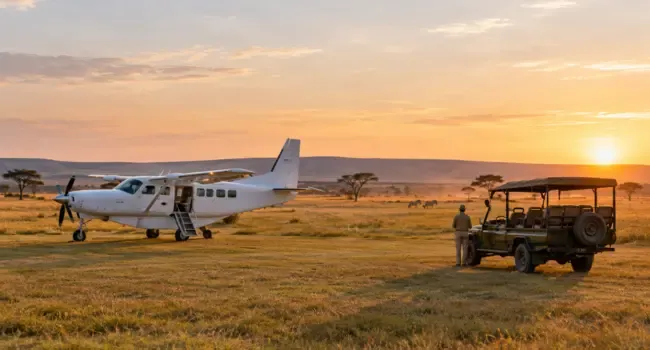
The flights to Masai Mara don't leave from the big international airport. They go from Wilson, on the other side of Nairobi, about 18km away - roughly 25 minutes in light traffic and an hour when it isn't. So the Wilson Airport to Masai Mara leg starts with immigration, a baggage belt and a drive across the city. Give it more time than you think, especially on a morning arrival.
From there the flights to Masai Mara take about an hour, against 5 to 6 hours by road with a rough final stretch. That gap is why most people fly, and why almost nobody who's driven it once drives it twice.
Worth thinking about when you book the long leg, too. If you're arriving on a Kenya Airways booking that lands early, you've got the morning to cross the city in comfort. A late-evening arrival usually means a night in Nairobi before you go anywhere.
Two things about the flight itself. First, the Masai Mara baggage allowance is 15kg per person including your hand luggage, in a soft bag - and soft bags with wheels and a handle are generally fine, which surprises people who've pictured a duffel. Hard shell cases do get turned away.
Second, these aren't point-to-point services. The aircraft works its way round several of the Masai Mara airstrips dropping people off, so the time on your ticket is the first landing, not necessarily yours. Ask what time your strip is expected rather than reading the departure board and assuming.
Check-in is 60 minutes at Wilson and 30 at a bush airstrip on the way home. The Masai Mara airstrips are spread across a wide area, so find out which one serves your camp before you fly - landing at the wrong one means a long drive at the end of a long day.
How Many Nights to Book
If you take one thing away, make it this. It decides more about a Masai Mara safari than the month does.
The rule is to count game drives, not nights. You arrive late morning and you leave late morning, so both of those days are half days. On a 2-night stay that leaves you 1 full day in the middle and roughly 4 drives. Three nights gets you about 4 or 5. Four nights gets you 6.
Two nights is the length people regret. Three is the practical floor. Four is what most say they'd book again - partly because a morning spent waiting on the Masai Mara migration with nothing happening then isn't a disaster.
The same logic applies if you're combining the Mara with Amboseli or Nakuru, and the safari flights Kenya runs make that hopping deceptively easy. Three to 4 nights per camp, and fewer camps. Transfers eat half a day each, and people visiting Masai Mara for the first time routinely plan 5 stops where 2 would have given them a better trip.
The Reserve or a Conservancy
Most people book without realising there's a choice here, and it changes the day quite a lot.
It matters almost as much as the best time to visit Masai Mara, and far fewer people think about it. The national reserve is the famous core, run by Narok County, and it holds the river frontage where the crossings happen. Around it sit more than 20 private and community conservancies on leased Maasai land, each working with a small number of camps - and several of the Masai Mara airstrips sit on conservancy ground rather than inside the reserve at all.
The difference that matters is written into the reserve's own rules. Night drives, walking safaris and horseback safaris aren't permitted inside the reserve, and that's deliberate - it's there so the conservancies can offer them. Ballooning is the one extra that is allowed inside. So if a night drive or a guided walk is on your list, where you sleep decides whether you get it.
The other difference is vehicle numbers, and it shapes the days more than the map does. Conservancies cap how many vehicles can be at a sighting, commonly around 5, and rangers do enforce it. In the reserve at peak season a good sighting draws a crowd, and a morning at a crossing point in August is a busy place. It's still a wonderful few days - it's just not a solitary one.
What people who've done both tend to recommend is splitting the stay: base in a conservancy for the quiet and the night drives, then give one full day to the reserve, especially if you're there for the Masai Mara migration. It costs nothing extra on the flying, because you land at the same handful of strips either way.
What Experienced Visitors Do Differently
People who come back a second time change a fairly consistent list of things, and you can simply do them on your first. Most of it is about deciding the best time to visit Masai Mara, then slowing down once you're there.
- They book a private vehicle - and near enough everyone who's tried it says they'd do it again. You decide when to leave, how long to sit with a sighting, and what the day is about.
- They pick fewer places and stay longer - dropping a park rather than adding one, and treating 3 or 4 nights as the minimum anywhere they stop.
- They take a full-day drive with a packed breakfast - instead of the default out-at-dawn, back-for-lunch, out-again rhythm that costs you the middle of the day.
- They ask for the same guide and brief them on day 1 - what you want to see, how you like to work, whether you'd rather sit with 1 leopard than tick off 6 species.
- They stay put at a sighting - rather than chasing every call that comes over the radio, which is how you end up in the queue rather than in front of it.
- They put the camera down - for part of each sighting. This one comes up again and again as a lesson learned rather than as advice given.
The common thread is patience, and it's worth more than anything else you'll spend on a Masai Mara safari. The Mara rewards sitting still far more than it rewards covering ground, and the gap between a good guide and an average one is mostly about knowing when to wait.
The Things First-Timers Learn on Day 2
None of these are complicated, and none of them depend on the best time to visit Masai Mara. They're the things you work out on your second morning and wish you'd known on the first.
It Is Genuinely Cold at 6am
Anyone visiting Masai Mara for the first time gets this wrong. The Mara sits high, and dawn temperatures run somewhere between 9 and 15 degrees. Then you sit in a vehicle with the roof up doing 30km/h, and the windchill turns that into something noticeably colder. By 9am you're peeling layers off, and by lunchtime it's in the high twenties.
What works: a fleece or zip layer over a t-shirt, a scarf or buff, and a hat with a chin strap because an ordinary one goes over the side. Most camps put blankets in the vehicle and a hot water bottle in the bed. Gloves are almost universally regretted.
The Dust Gets Into Everything
Fine, red and relentless, and it starts the moment you step off at one of the Masai Mara airstrips. A buff pulled up over your face on a moving vehicle is the single best bit of kit you'll pack. Wet wipes are worth their weight. If you're shooting, plan to clean the lens between drives and to change lenses as little as possible - which is the real argument for one long zoom over a bag of primes.
Neutral Colours, but Not for the Reason You've Been Told
Every packing list you'll read says avoid blue and black because of tsetse flies. The more useful reasons are simpler: white doesn't survive the dust, black holds the heat, and neutral tones just look less conspicuous in photographs. Animals are reading the vehicle, not your shirt.
Pack fewer clothes than you think and use the camp laundry. It's the biggest single space saving anyone reports, and it matters when you're working to the Masai Mara baggage allowance.
Charging Is Not What You Expect
Plenty of camps run a generator that goes off overnight, and charging points are often at a central spot rather than in your tent. Hairdryers and other high-draw things frequently won't run at all. Bring a decent power bank and a small multi-way adapter, and if you depend on a mains-powered medical device, contact the camp directly well before you travel rather than going through an agent.
Bring a Refillable Bottle
Kenya banned single-use plastics - bottles, cups, cutlery, straws - in national parks, beaches, forests and conservation areas in June 2020, on top of the nationwide bag ban already in force. Camps supply filtered water and guides carry cold water in the vehicle, so for anyone visiting Masai Mara a refillable bottle isn't a preference, it's how it works.
For Photographers, Reach Beats Speed
The most repeated regret among people who shoot is wishing they'd been closer, not wishing they'd had a faster lens. A long zoom, a bean bag rather than a tripod, more memory cards than you think, and a backup routine you actually run every evening. Just remember the lot has to fit the Masai Mara baggage allowance alongside your clothes.
Worth Doing Before You Fly
Most of this costs nothing and takes minutes, and all of it is easier now than at the Wilson Airport to Masai Mara check-in desk.
- Settle the best time to visit Masai Mara first - crossings and company, or space and green grass. They're different holidays.
- Book 3 nights minimum, 4 if the budget stretches - more nights means more drives, and drives are the whole product.
- Decide reserve or conservancy before you pick a camp - it settles whether night drives and walks are even possible on your Masai Mara safari.
- Ask whether your game vehicle is private or shared - and if shared, whether everyone gets a window seat.
- Find out which of the Masai Mara airstrips serves your camp - and tell the camp which flight you're on.
- Weigh your bag at home - the Masai Mara baggage allowance is 15kg all in, soft-sided, and wheels are fine.
- Leave real time before the Wilson Airport to Masai Mara departure - the 2 Nairobi airports are a city apart.
- Pack a fleece, a buff and a hat with a strap - the 3 things people wish they'd brought.
- Ask your camp about power and charging - before you arrive, not after.
- Talk to your doctor about malaria precautions - well ahead of travel, not the week before.
And keep some cash. Not everywhere out there takes a card, and the nearest machine is a long way from the Masai Mara airstrips.
The Mara Rewards a Slower Trip
Almost everything that makes a Mara trip memorable comes down to 2 decisions you make long before you leave: how long you stay, and where you base yourself. The best time to visit Masai Mara matters, the camp matters, the guide matters enormously - but a patient 4 nights in one place beats a hurried 8 across four parks, every time.
Get to Nairobi on whatever suits you - direct, or on an Ethiopian Airlines booking through Addis, which is only 2 and a half hours out - then give yourself the extra night. The animals were never going to run to schedule anyway.
Disclaimer - General information drawn from Kenyan government wildlife and tourism publications, the reserve's own management plan, peer-reviewed research, airline schedules and published traveller feedback, current as at September 2026. Wildlife sightings are never guaranteed, rules and schedules change without notice, and health questions belong with a doctor. Confirm details with your camp and airline before you travel.
Frequently Asked Questions
When Is the Best Time to Visit Masai Mara?
July to October for the dry season and the Masai Mara migration, which reaches Kenya somewhere between July and September, and it's the busiest window of the year. January and February for big cats on open ground with far fewer vehicles. April and May if you want the place close to empty and don't mind rain. August is spectacular and it's also Kenya's busiest month, so the best time to visit Masai Mara depends entirely on which of those matters more to you.
How Do I Get to the Masai Mara from Nairobi?
Fly from Wilson Airport, which sits about 18km from the main international airport on the other side of the city. The Wilson Airport to Masai Mara hop takes about an hour, and the aircraft usually calls at 1 or 2 other Masai Mara airstrips on the way. Driving takes 5 to 6 hours with a rough final stretch, which is why most visitors take the flights to Masai Mara instead.
What Is the Baggage Limit on Safari Flights in Kenya?
The Masai Mara baggage allowance is 15kg per person on the light aircraft, and that figure includes your hand luggage rather than sitting on top of it. Soft-sided bags only, though soft bags with wheels and a handle are generally accepted on the safari flights Kenya operates. Hard shell suitcases get refused.
How Many Nights Should I Spend in the Masai Mara?
Three at a minimum, 4 if you can. Arrival and departure days are half days, so 2 nights gives you roughly 4 game drives while 4 nights gives you 6. Anyone visiting Masai Mara should book around that arithmetic rather than the other way round.
Will I See the Big Five?
Lion, elephant and buffalo are all likely on a 3-night Masai Mara safari. Black rhino are present but few - 54 at the last count. Leopard are around in low numbers and mostly at the edges of the day. Treat rhino and leopard as a bonus and you'll come home happy.
Is It Better to Stay in the Reserve or a Conservancy?
The reserve holds the river frontage, which matters in crossing season. Conservancies cap vehicle numbers at sightings and allow night drives and walking safaris, which the reserve doesn't. Plenty of visitors split the stay and get both, and the flights to Masai Mara land at the same strips whichever you choose.
 Nikita Aswani